Open-source software, MIT licensed
Biopharma intelligence you can check line by line.
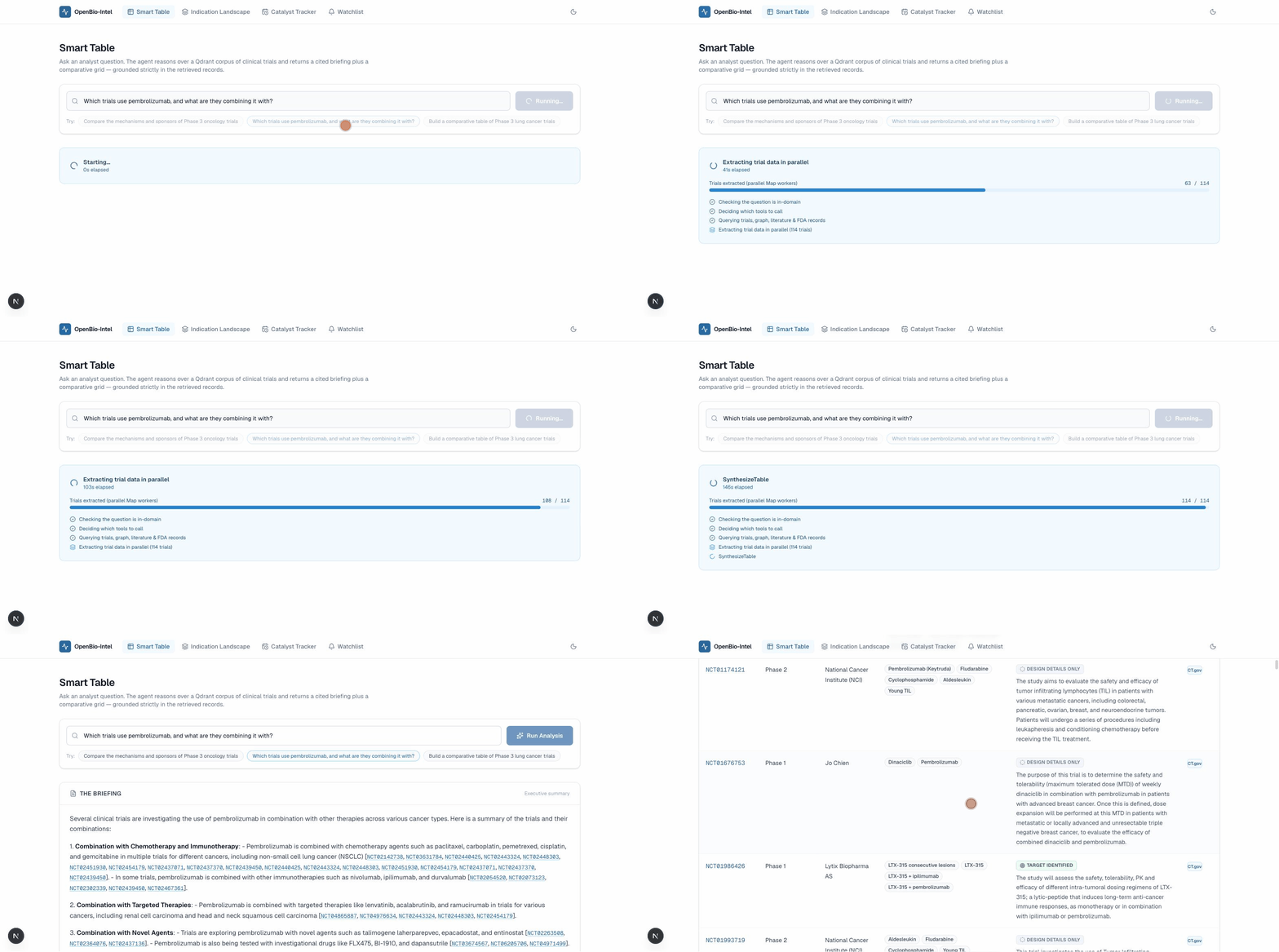
Which trials use pembrolizumab, and what are they combining it with?
In first-line non-small-cell lung cancer, pembrolizumab is combined with pemetrexed and platinum chemotherapy1 and, in squamous disease, with carboplatin plus paclitaxel or nab-paclitaxel.2
In advanced renal cell carcinoma it is paired with tyrosine kinase inhibitors: axitinib3 and lenvatinib.4 Its approval history sits under the biologics application BLA 125514.5
Abstract
Commercial biopharma intelligence platforms are closed, priced per seat, and opaque about how their answers are produced. OpenBio-Intel is an open alternative. An agent searches seven hybrid-indexed collections holding more than 630,000 records plus a drug knowledge graph, extracts structured findings from each matching trial in parallel, and writes an answer in which every row and claim cites its source. It runs on your own infrastructure, so your questions never leave it.
1Why build this in the open
Trial registries, FDA databases, SEC filings and press releases are public. Most of what commercial platforms sell is the layer on top: extraction, entity resolution and monitoring. That layer decides which trials count, which drug names match and which numbers end up in a slide deck, and today it is a black box.
OpenBio-Intel puts that layer in a repository you can read. When a number looks wrong you can trace exactly how it was produced. When you need a new source, you add it. And because it is self-hosted, the questions your team asks, which are competitive intelligence in their own right, stay inside your network.
2Three instruments, one retrieval layer
Each instrument answers a different shape of question. They share the same sources, search and citation rules.
2.1Smart Table
Ask a question and get a cited briefing plus a comparison grid. The agent fans out one extraction worker per matching trial, shows live progress, and attaches a registry link to every row, with PubMed, SEC or news citations added only when that evidence was actually used. Export the grid to Excel or PowerPoint without re-running anything.
2.2Indication Landscape
Name a therapeutic area and get a competitive matrix: mechanism or target down the side, development phase across the top. Every cell is grounded in retrieved trials, FDA records and literature, and opens to the records behind it.
| Mechanism | Phase 1 | Phase 2 | Phase 3 | Approved |
|---|---|---|---|---|
| PD-1 / PD-L1 inhibitor | ||||
| KRAS G12C inhibitor | ||||
| TROP2 antibody–drug conjugate | ||||
| EGFR tyrosine kinase inhibitor | ||||
| Bispecific T-cell engager |
2.3Catalyst Tracker
A timeline of upcoming events that move markets: Phase 3 primary completions, PDUFA action dates and advisory committee meetings. PDUFA dates are not published by the FDA, so like every commercial calendar they are mined from company filings and press releases. Here, each event shows the disclosure it came from.
- Q1Phase 3 primary completionfrom the trial registry
- Q2Advisory committee meetingfrom a company 8-K
- Q2PDUFA action datefrom a press release
- Q4Topline readout expectedfrom an earnings call
2.4Watchlists
Watch a drug, company, trial or topic. One check compares ClinicalTrials.gov updates and new FDA rejection letters against your last run and shows only what changed.
3Methods
3.1Sources
Everything comes from public primary sources. Some are indexed ahead of time, and some are queried live when you ask.
| Source | What it provides | Access |
|---|---|---|
| ClinicalTrials.gov | About 600K trial records: design, phase, sponsors, interventions, conditions, dates | Indexed, plus live |
| openFDA Drugs@FDA | Approvals, application numbers, products, ingredients | Indexed |
| FDA Complete Response Letters | Full-text rejection letters, 2025 onward | Indexed |
| PubMed Central | Peer-reviewed full text from the open-access subset | Indexed |
| SEC EDGAR | Pipeline and R&D sections of 10-K and 8-K filings | Indexed |
| Corporate news | Press releases and earnings-call transcripts | Indexed |
| FAERS | Post-market adverse events, with reporting odds ratios and 95% intervals | Live |
| Orange Book | Small-molecule patents and exclusivity, 10,869 products | Graph |
| Purple Book | Biologic exclusivity, 938 applications reconstructed | Graph |
| Conference posters | Efficacy and safety tables that registries don’t carry | Indexed |
| AACT | Exact SQL over all of ClinicalTrials.gov | Optional |
3.2From question to cited answer
A classifier first checks that the question is in scope. A tool-calling agent then decides which sources apply. Drug names are resolved through a Neo4j graph built from RxNorm, so “Keytruda”, “pembrolizumab” and “MK-3475” match the same trials by exact traversal rather than by similarity. Text search fuses keyword and embedding results, and a cross-encoder reranks them. One extraction worker runs per matching record, and a final step writes the answer with its citations.
4Results
Retrieval quality is measured, not asserted. The golden set, harness and baseline are committed to the repository, and CI runs the comparison as a regression gate. Ground truth comes from exact filters on the stored records, so the retriever being tested plays no part in defining what counts as relevant.
Search using embeddings alone found nothing relevant for 13 of 50 realistic analyst queries, mostly ones naming exact development codes such as ABX464 or BBO-10203 that embeddings blur. Adding keyword search and reranking cut that to 7 and lifted mean recall by more than a third.
| Configuration | Recall@20 | Hit rate | No result |
|---|---|---|---|
| Embeddings only | 0.44 | 0.74 | 13 / 50 |
| + keyword search, fused | 0.59 | 0.84 | 8 / 50 |
| + cross-encoder rerank | 0.61 | 0.86 | 7 / 50 |
5Discussion
Mature platforms such as Cortellis and AlphaSense have decades of hand-curated records, consensus forecasts, investigator databases and support teams behind them. OpenBio-Intel does not try to fake any of that. It is the better choice when you need intelligence you can audit, host yourself and extend.
| OpenBio-Intel | Commercial platforms | |
|---|---|---|
| Source code | Open, MIT license | Proprietary |
| Hosting | Your infrastructure | Vendor’s cloud |
| Your queries | Stay on your network | Seen by the vendor |
| Citations | Every claim links to a record | Varies |
| Cost | Your servers plus model API usage | Per-seat subscription |
| Agent access | Built-in MCP server | Built for human UI |
| Forecasts and deal terms | Not offered | Curated by analysts |
5.1Known limitations
- Purple Book coverage is partial, because the FDA publishes no complete extract. Results say so.
- ASCO, ESMO and AACR abstracts are not ingested; their licenses forbid redistribution. Readouts are covered through company press releases and 8-Ks.
- PDUFA dates are extracted from company disclosures, not official FDA data. Each one carries its source.
- The quickstart seed is 100 records, enough to try the interface. A research-grade corpus takes hours to ingest and has real embedding cost.
6Availability
6.1Run it locally
You need Docker, an OpenAI key for embeddings and an Anthropic key for the agent. The script starts Qdrant, Neo4j, the API and the web app, then loads a small seed so you can try a query straight away at localhost:3000.
git clone https://github.com/JAGAN666/OpenBio-Intel.git
cd OpenBio-Intel
./quickstart.sh6.2Use it from Claude
The bundled MCP server exposes every tool and the full Smart Table pipeline to Claude Desktop, Claude Code or any MCP client, running against your own data.
{
  "mcpServers": {
    "openbio-intel": {
      "command": "uv",
      "args": ["run", "--project", "/path/to/OpenBio-Intel",
               "python", "mcp_server.py"]
    }
  }
}6.3Deploy it
The repository includes a reference AWS deployment in Terraform (ECS Fargate, a load balancer and EFS) with a GitHub Actions pipeline. It is optional; Docker Compose on a single machine works too.
Cite this software
If OpenBio-Intel supports your research, please cite it.
@software{narayanaswamy_openbiointel,
  author  = {Narayanaswamy, Jagannath},
  title   = {OpenBio-Intel},
  version = {0.1.0},
  license = {MIT},
  url     = {https://github.com/JAGAN666/OpenBio-Intel}
}
Created and maintained by Jagannath Narayanaswamy. Contributions are welcome: see the contributing guide or open an issue.